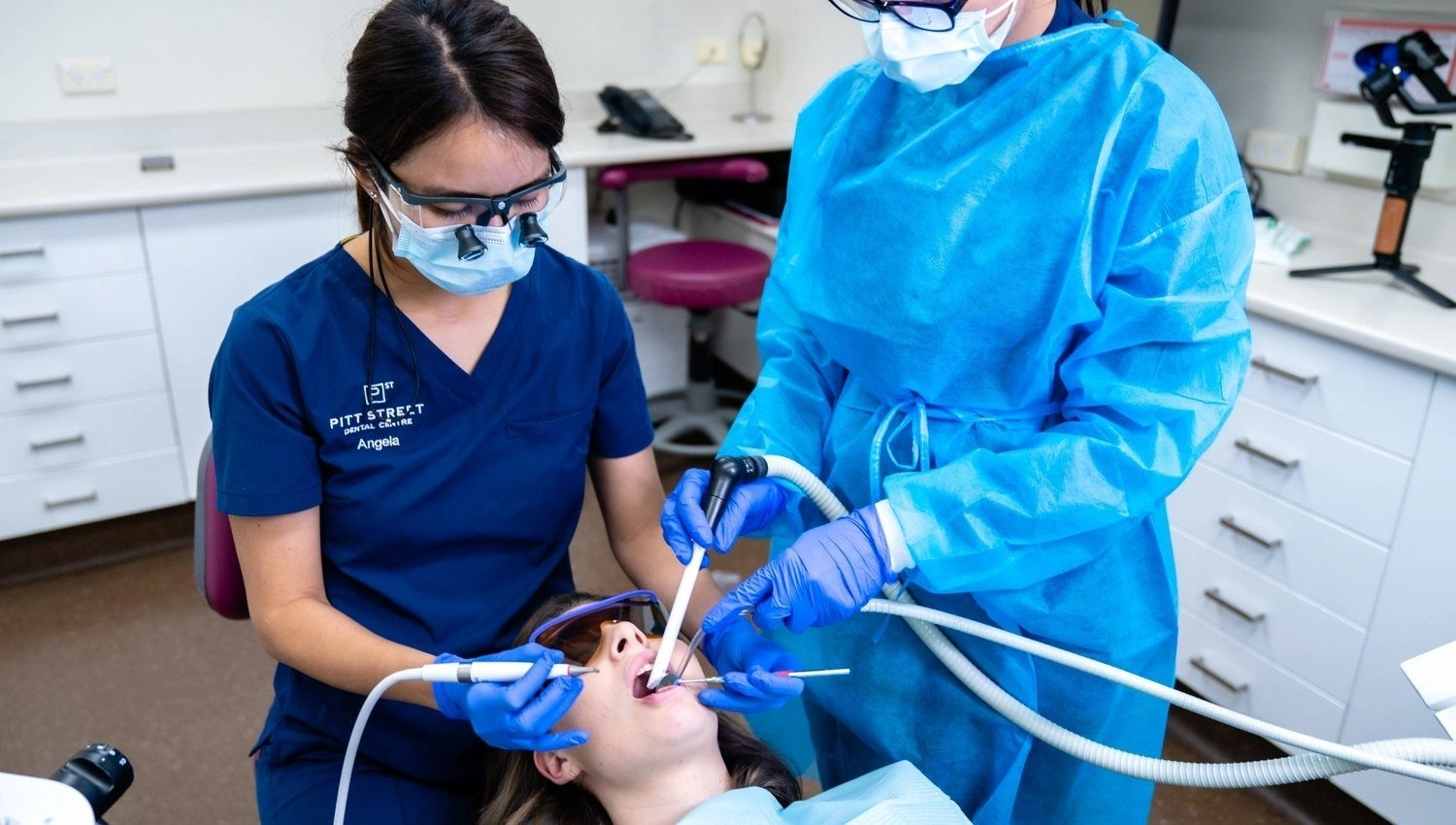
Until about a decade ago, good mouthguards came from the dentist. Designed from a cast of the wearer’s dental impression, the fit has to be specific to the bite in order for it to be the optimum safeguard against oral damage or dentofacial injuries from the unfortunate smash of equipment or an opponent.
A mouthguard works by shielding, cushioning and spreading the kinetic force of a facial blow. For wearers of braces too.
Now, it’s biometrics that measure and calculate an individual’s physical characteristics, performance and game strategies to better protect the many vulnerabilities of the face, mouth and brain. A customised mouthguard is mandatory in the participation of almost any contact sport.
Except surfing. A sport of full and limited impact and collision, and one of the most physically demanding and dangerous pastimes is neither considered nor categorised as a contact sport because it doesn’t look like one. It doesn’t look like one because it seems such a seamless fusion of human to water, air, earth and a sky-ball full of fire.
There’s no shortage of accident or injury that can can change that enjoyable outdoorsy moment to something completely different in a second split like an atom.
Shark attacks are rare, and a parcel of distant data unless it happens to you. Almost sixty incidents of Selachii and human interaction occurred in Australian waters between 2024 and October 2026. Eleven were fatal. The remainder is a menu of blood-stained sea, severed limbs, bone-exposing wounds, horrors and heroics. A recent survivor was unfazed when the fisheries department informed him it was unable to precisely identify what it was that took his lower leg.
“A shark took my leg,” he said. “It wasn’t an elephant, and it wasn’t a donkey.”
The level of knowledge and risk-management in surfing far extends rips, rocks, reefs and weather. Drownings happen. Cuts and lacerations are the most common injuries requiring medical assistance, with 60% of them to the head and face.
Given the good portion of head real estate occupied by all that lets us masticate and communicate, it’s a statistic heavily weighted to a 1-in-3 chance of the mouth, teeth or jaw being affected. Even temporarily losing the ability to effectively chew and talk takes an enormous toll on the easy enjoyment of living. High-velocity impacts with pounding surf, shallow reefs, the ocean floor, your own board or someone else’s means broken teeth and facial bones are not a massively uncommon end to a session.
Even for the pros.
Hawaiian Koa Rothman knows what it’s like to be wiped out by the flight of a 9-foot loose board that smashes your face and leaves you with concussion and shattered teeth kilometres from shore on a remote, deep-water outer reef; a place never disclosed other than being “somewhere in the Southern Hemisphere”.
Such is the modern risk of the unrelenting uncreativity of social media creators who do nothing but popularise, pummel and pulverise anything of natural beauty into utter ruination. They do it to their own faces.
Not only did Rothman swallow the shock and unimaginable pain, he also swallowed his snapped-in-half teeth. Tooth nerves exposed. It takes perspective and a certain type of thinking to get through something like that.
Assuming the high quality customisation of this imaginary mouthguard, it may have prevented the shattered teeth, ensuant swallowing and terrible soft tissue lacerations. With an impact comparable to a 60kph car crash, the distribution of force attributed to this dreamed-up dental guard would have been across the entire dental arch, midface and upper and lower jaw.
And maybe a mouthguard wouldn’t have helped.
Equally, with the protective position of teeth as locked, such immense energy can also travel directly to the skull or jawbone, resulting in fractures of either – or both.
Such is a sport not considered combat or contact with risks. Where unrestricted breathing, and the ability to communicate quickly, loudly and clearly alter the view of mouthguards in the way a sunrise over water does to a distant tinnie.
It’s much more clear cut for recreational and pro players of MMA and all combat sports, both forms of hockey, any of the footy codes, as well as lacrosse.
Lacrosse. The macrame of sport. Where you appreciate the steep learning curve, the skill and the practice, but never ever understand why.
Even as a minor sport, 64-75% of injuries incurred are of the head, face and eyes.
The lightweight rigidity afforded by the carbon fibre, composite plastics and titanium that make crosse shafts coupled with the high speed tactics and moves of game, mouthguards are not only mandatory, but must be coloured, not white, and not clear – so compliance can be instantly verified during play. Ball speed can exceed 100kph in games for 8-to-14-year-olds. It’s a sport that risks teeth and oral tissue and as with all mouthpieces for proper protection, fit matters. A custom guard made by a dental professional takes away the simmering guesswork of a boil-and-bite.
Then there are smart mouthguards.
These provide real-time data of head impact from sports collisions that detects potential brain injury. Tiny sensors record the direction, location, frequency and severity of any force upon the head. Linear and rotational acceleration is tracked up to 15,000 times a second.
A second.
Via accelerometers, gyroscopes and proximity sensors, this Bluetooth-enabled technology collects data to measure impact. A discernible red light flashes from the buccal cavity of the mouthpiece and data is sent directly to the medics if the danger of concussion or head trauma has registered, being anything above a predetermined threshold. The player is immediately given an off-field, clinical evaluation. It’s part of the progression of not wanting a repeat of the situation world rugby authorities currently find themselves in, with hundreds of ex-players seeking legal recourse, citing negligence by governing bodies in taking reasonable preventative measures to protect participants from brain injury.
There is no doubt that properly fitted mouth protection greatly alleviates the risk of dental trauma. Broken, chipped or cracked teeth account for 50% of them. Teeth pushed into the jawbone, sideways or knocked out of their socket are other dental emergencies – even sometimes hand-in-hand with jaw and facial fractures.
There are fewer pursuits more worthwhile than excelling in a sport, mastering an instrument and conquering another language. Shore up the chances of the latter two by wearing the best, most suitable mouthguard for the sport you choose.
And if you really can’t wear one, be a sport. Give yourself a sporting chance and choose another sport.