Same-day All-On-4 Sydney CBD
All Teeth on 4 is a full-arch tooth replacement technique that uses four strategically placed dental implants to support a complete set of fixed teeth in a single jaw. It is designed for patients who have lost all their teeth or whose remaining teeth are failing and need to be replaced entirely.
Here at Pitt Street Dental Centre in Sydney CBD, Dr Michael Cai has placed over 3,000 dental implants personally across 18+ years of focused practice. Our All Teeth on 4 procedure uses Straumann implants exclusively and includes extractions, implant placement, a same-day provisional prosthesis, and the final prosthesis in one complete fee.
In suitable cases, patients leave with fixed functional teeth on the same day as their surgery.
Walk in with failing teeth. Walk out with fixed new teeth.
Walk in with failing teeth. Walk out with fixed new teeth.
Dr Cai removes failing teeth, places implants, and fits a fixed temporary prosthesis, all in one surgery. From $25,000 per arch, fully inclusive.
At Pitt Street Dental Centre, in suitable cases, Dr Cai attaches a fixed temporary prosthesis to your implants on the same day as surgery. It doesn’t come out. It doesn’t move. You eat soft food the same evening. You leave with teeth.
Why Choose Same-Day All-on-4 in Sydney CBD?
Most clinics make you wait six months for a tooth. We work to shorten that.
“All-On-4” means different things at different clinics. At many practices, the teeth you leave with after surgery are a removable healing denture, an appliance that comes out at night, that can move when you eat, and that you wear for 3 to 6 months while your implants integrate. Only after that do you receive your final fixed bridge.
At our clinic, in suitable cases, Dr Cai attaches a fixed temporary prosthesis to your implants on the same day as surgery. It doesn’t come out. It doesn’t move. You eat soft food the same evening. You leave with teeth.
Same-day fixed loading requires sufficient bone for immediate implant stability. Not every patient has this on day one, and if you don’t, we’ll be honest about it. For patients with severe upper-jaw bone loss who aren’t suitable for standard All-On-4, we offer zygomatic and pterygoid implants in collaboration with a maxillofacial surgeon, a graftless solution that can still deliver fixed teeth in many cases.
How Does the Same-Day All-on-4 Dental Implant Procedure Work?
How same-day All-On-4 works at our clinic.
The procedure takes place across three stages on a single surgical day.

Extractions. All failing or non-restorable teeth in the arch are removed. Included in the $25,000 fee.

Implants placed. 4 to 6 premium Swiss Straumann implants are placed at angles designed to maximise stability and minimise the need for bone grafts.

Fixed teeth attached. A fixed temporary prosthesis is attached to the implants. You leave with teeth. The final prosthesis is fitted at 3 to 6 months. Both are included in the $25,000 fee.
The entire procedure takes approximately 4 to 6 hours under twilight sedation in our Sydney CBD clinic. For patients who prefer general anaesthesia, the procedure can be performed in hospital theatre at Westmead Private or Strathfield Private, where Dr Cai is accredited at both.
About Dr Michael Cai
3,000+ implants placed. 18+ years. UCLA-trained. Hospital-accredited.
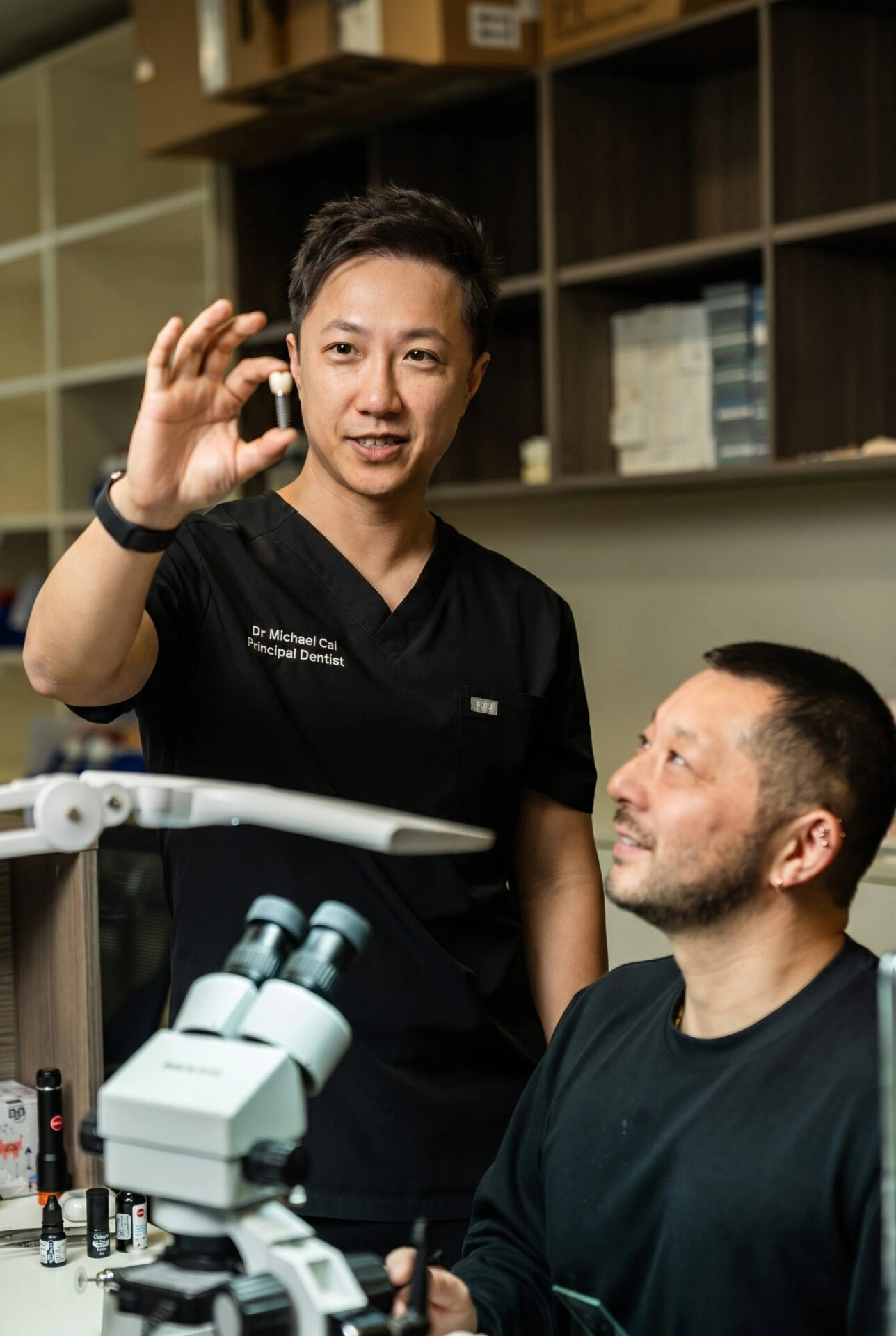
Dr Michael Cai has placed and restored over 3,000 dental implants over more than 18 years of focused implant practice — placing him among the most experienced implant dentists in Australia by personal case volume. Across Pitt Street Dental Centre, the team has over 5,000 dental implants of combined experience.
Dr Cai completed the Master Clinician Program in Implant Dentistry at the University of California, Los Angeles, and additional training at the GIDE Institute. He holds a Bachelor of Dental Science with Honours from the University of Western Australia and is a member by examination of the Royal Australasian College of Dental Surgeons (MRACDS GDP). His research has been published in international dental journals.
Dr Cai is accredited at both Westmead Private Hospital and Strathfield Private Hospital, allowing complex procedures — and patients who prefer general anaesthesia — to be managed in a hospital theatre setting. He also trained as a dental technician before practising dentistry, giving him an unusually deep understanding of how implant restorations are designed and fabricated.
Credential List:
Hospital-Grade All-on-4 Surgery in Sydney
Twilight sedation in clinic, or general anaesthesia in hospital theatre. Your choice.
Most full-arch procedures are performed in our Sydney CBD clinic under twilight sedation. You’re comfortable and unaware of the procedure, but recovering quickly. For patients with significant medical history, severe dental anxiety, or who simply prefer general anaesthesia, Dr Cai is accredited to perform surgery at Westmead Private Hospital and Strathfield Private Hospital. A specialist anaesthetist manages the anaesthesia. Most Sydney CBD dental clinics cannot offer this option.
Should You Consider Overseas?
What the overseas price doesn't include.
We regularly see patients return from overseas dental tourism needing revision surgery. Implant failure, ill-fitting prostheses, soft tissue complications, and components that aren’t available locally. The same day all on 4 issues we see most:
If you’ve already had overseas work and need aftercare or revision, we can help. For initial treatment, we’d encourage you to compare like-for-like. Get an itemised quote from any Sydney clinic and ask what’s not included. Our $25,000 all-in fee often compares more favourably once overseas hidden costs are added.
What Are the Risks of Same-Day All-on-4?
Full-arch implant treatments can restore function and stability, but as with any same day all on 4 surgical procedure, there are risks and recovery considerations.
Possible risks may include:
- Swelling, bruising or discomfort in the days following surgery
- Minor bleeding during the initial healing period
- Infection or delayed healing in rare cases
- Risk of implant failure if proper healing does not occur
- Nerve irritation or sinus involvement, depending on implant placement
- Higher risk of failure if you smoke or vape
Recovery considerations:
- Initial healing usually takes one to two weeks
- Temporary teeth are often provided within days of surgery, with final teeth placed after full healing
- Full osseointegration of implants typically requires several months
- Patients are advised to follow a soft diet during early healing and attend all follow-up visits
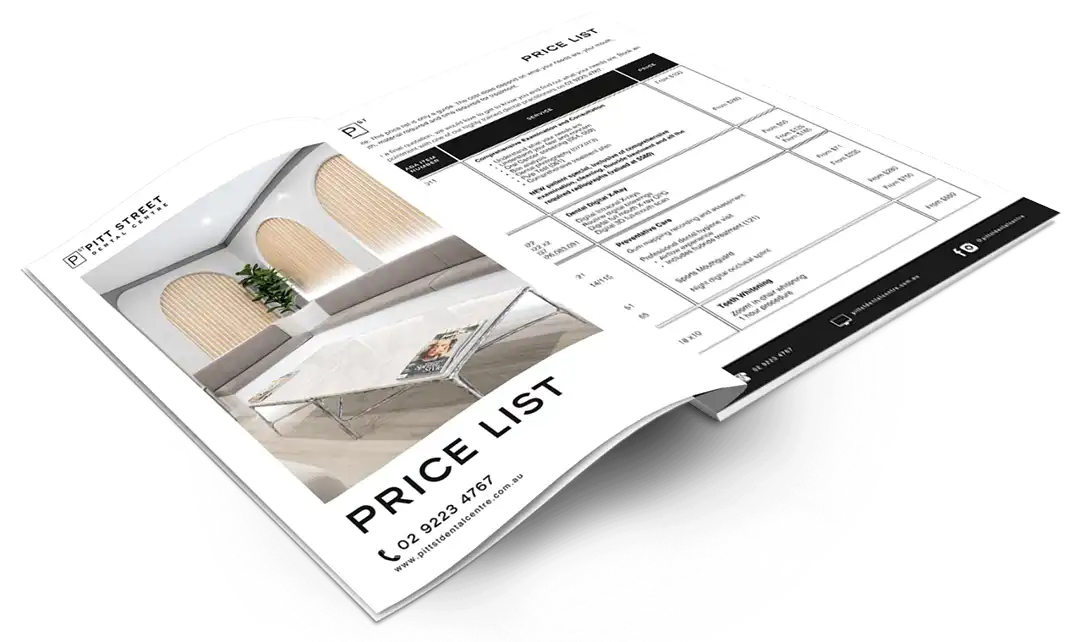
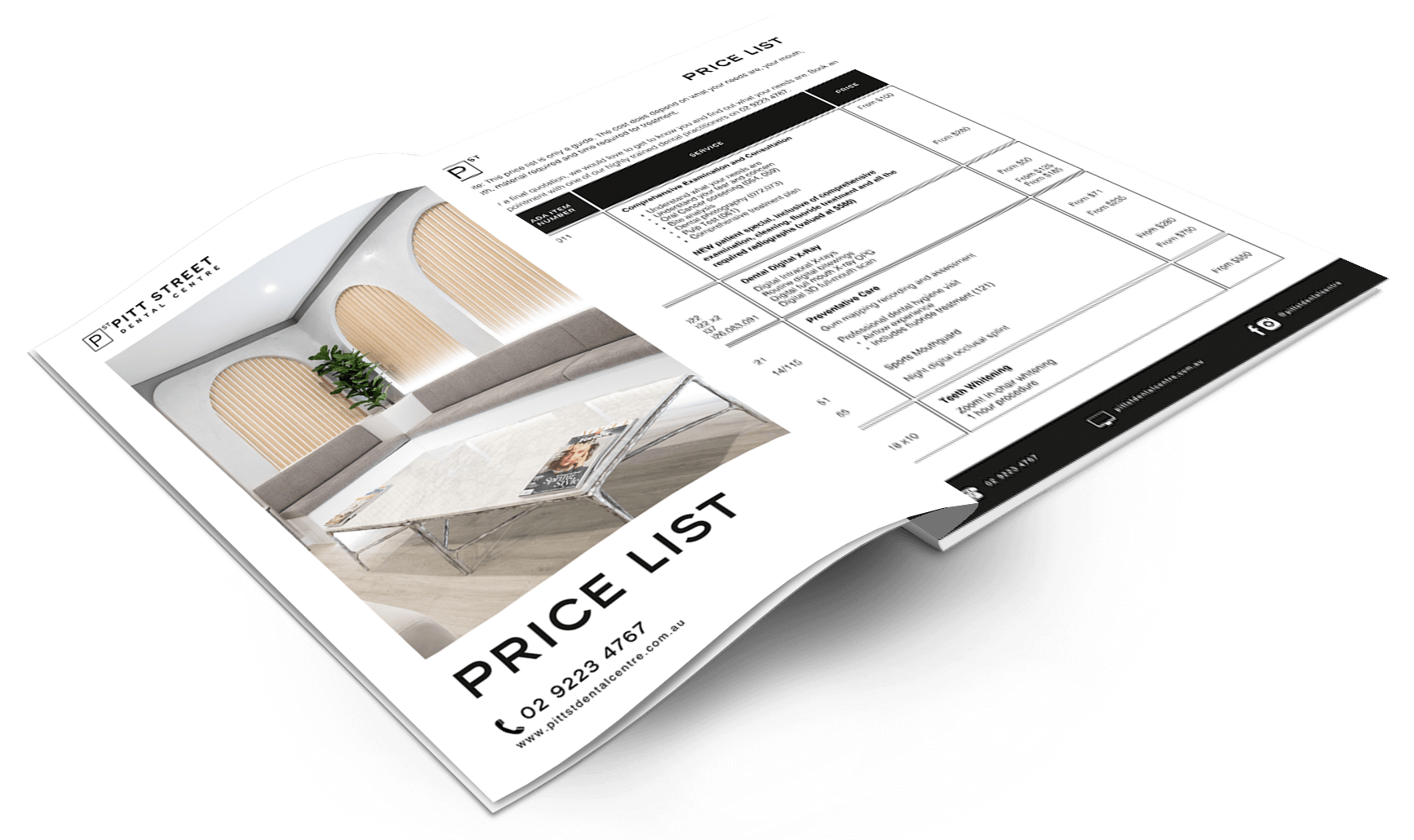
Download Our Price List
Download Our Price List
We take great pride in providing a tailored treatment experience. Everyone’s dental needs are different, which is why we discuss options that are relevant to your specific situation and goals.
Frequently Asked Questions
What are all teeth on 4?
All Teeth on 4 is a full-arch tooth replacement technique that uses four strategically placed dental implants to support a complete set of fixed teeth in a single jaw. It is designed for patients who have lost all their teeth or whose remaining teeth are failing and need to be replaced entirely.
Does $25,000 really include everything?
Yes. Surgery, all extractions in the arch, 4 to 6 Straumann implants, same-day temporary prosthesis, and final prosthesis are all included. Bone grafting is rarely required with our angulated placement protocol, but if it is needed in your case it will be included in your written quote. General anaesthesia in hospital theatre is an additional cost if you elect it. You receive a complete written quote after your consultation with nothing hidden.
Am I a candidate for same-day fixed All-On-4?
Most patients we see are candidates. We assess bone density, gum health, and your medical situation using a 3D CBCT scan at consultation. For patients with severe upper-jaw bone loss who aren’t suitable for standard All-On-4, we offer zygomatic and pterygoid implants in collaboration with a maxillofacial surgeon, a graftless solution that can deliver fixed teeth without bone grafting.
How long does surgery take?
Typically 4 to 6 hours per arch. Most patients prefer twilight sedation, in which case it’s done in our CBD clinic and you’re back home the same evening. For those choosing GA, it’s performed at Westmead Private or Strathfield Private hospital. Most patients return to office work within 3 to 5 days.
When do I get my final teeth?
You leave with a fixed temporary prosthesis on surgery day. The final prosthesis, typically zirconia or a hybrid material, is fitted 3 to 6 months later once your implants have fully integrated. Both are included in the $25,000 fee.
Can I use my super?
Yes, in many cases. Early Release of Superannuation is one of the most common funding paths for full-arch patients. We work with SuperCare and similar services. Eligibility is determined by the ATO. We’ll walk you through the process.
Find out if fixed teeth implants are right for you
Book a $250 consultation, credited back when you proceed with treatment. Dr Cai will take a 3D scan, give you an honest clinical assessment, and provide a written itemised quote. Bring any prior quotes or scans you’ve had elsewhere. Most consultations run 45 to 60 minutes.
DISCLAIMER: The material posted is for informational purposes only and is not intended to substitute for professional medical advice, diagnosis or treatment. Results vary with each patient. Any dental procedure carries risks and benefits. If you have any specific questions about any dental and/or medical matter, you should consult your dentist, physician or other professional healthcare providers.
Medically Reviewed by Dr Michael Cai, BDS (Syd), Implant Specialist
Last Reviewed: August 14, 2026
INSIGHTS & INSPIRATION
When Can I Start Eating Normally Again After Getting All-Teeth-On-4 Dental Implants
How Do I Find a Qualified Dentist or Oral Surgeon to Perform the All-Teeth-on-4 Procedure
Are there any potential complications or risks associated with All-Teeth-on-4 implants
What Is the Recovery Time After Getting All-Teeth-on-4 Implants
Watch More
INSIGHTS & INSPIRATION
Watch MoreCELEBRATED SMILES
A gallery of memorable moments with beautiful patients who trust us with their smiles.