Any light shed on gum disease is a very welcome thing. It affects more than 70% of the world population and is responsible for more than just wrecking your gums. It earns its global health issue rock-star status because it’s a disease that travels to parts not only far and wide, but to places previously unknown to it. Like the tedious and talentless do with private jets, super yachts and submersibles.
Gingivitis is the easiest of gum diseases to effectively treat when it’s properly recognised as a dental issue, rather than one-more-thing to a TikTok answer shopping list. Even with the misguided belief that it can be completely and successfully remedied at home, needs the proof of a dental appointment as a major part of the end result.
Most of the time, that’s never factored in anywhere. The whole point of the home remedy for many, is to avoid the cost, or the terror, or the logistical impossibility of physically turning up to a dental clinic.
For millennia, herbal medicines have been used to treat and cure anything that showed up and made us not want to have it.
Complementary and alternative treatments stretch centuries. For anything from infestations to indigestion to inflammatory bowel disease. Not only do swathes of them work, it’s a field day for dissertations, pharmaceuticals, folklore, bad jokes and arguments. Dentistry researches and studies remedial approaches of the past. The active compound in cloves (eugenol) is a natural anaesthetic, antiseptic and anti-inflammatory. Mixed with zinc oxide, it’s used on a daily basis by clinicians as a temporary filling for root canals and irritated teeth. As it’s the phytochemicals in herbs that carry these types of properties, gels, solutions and pastes use extracts in the prevention, management and intervention of oral disease. Painless dentistry for patients came as the result of coca leaf chewing practiced by indigenous South Americans. Isolating its phytochemical in the late 1880s brought the marvels of cocaine along with its name, and announced the arrival of the first true anaesthetic to dentistry and surgery like a pyrotechnic display.
For some, it was light that never went out.
Gum disease is easier to prevent than it is to treat – as are most ailments and afflictions of the human body in the same way a dish will never break if it’s never been unwrapped. Prevention is usually where we become most focused when it’s already too late; something else to add to the pyre of If Only I Had, and I Only Wish I’d Known.
It’s hard. It’s hard to even know which type of toothbrush to use. While most dentists maintain that soft-bristle is always the one, others claim that it fails to provide proper gum stimulation which allows periodontal pockets to develop and persist. The only way to check whether you have them or not, is to see a dentist
Most people have no idea they have gum disease because it doesn’t always hurt.
And it quietly spreads. It’s not just a mouth issue, it’s a whole-body inflammation signalling there’s a show on. A 34% increase in the risk of heart disease. A 26% greater chance of diabetes is no sweetener for the 67% escalation in the chance of developing Alzheimer’s, so forget about even wondering whether having gum disease should be treated and monitored by a qualified dentist.
Along with routine 6-monthly check-ups and professional cleaning, scaling and root planing, laser therapy, grafts and surgeries are the general procedures for restoring gum tissue health.
It’s possible for gingivitis and periodontitis to be treated with a homemade paste. One teaspoon of turmeric, 1⁄2 teaspoon Himalayan salt, and 1⁄2 teaspoon of mustard oil applied to the gums twice daily is a beneficial, not standalone treatment. In no way does it negate the need for the knowledge and expertise of a clinician to properly identify the disease, and quantify the level of effectiveness in stopping its progression.
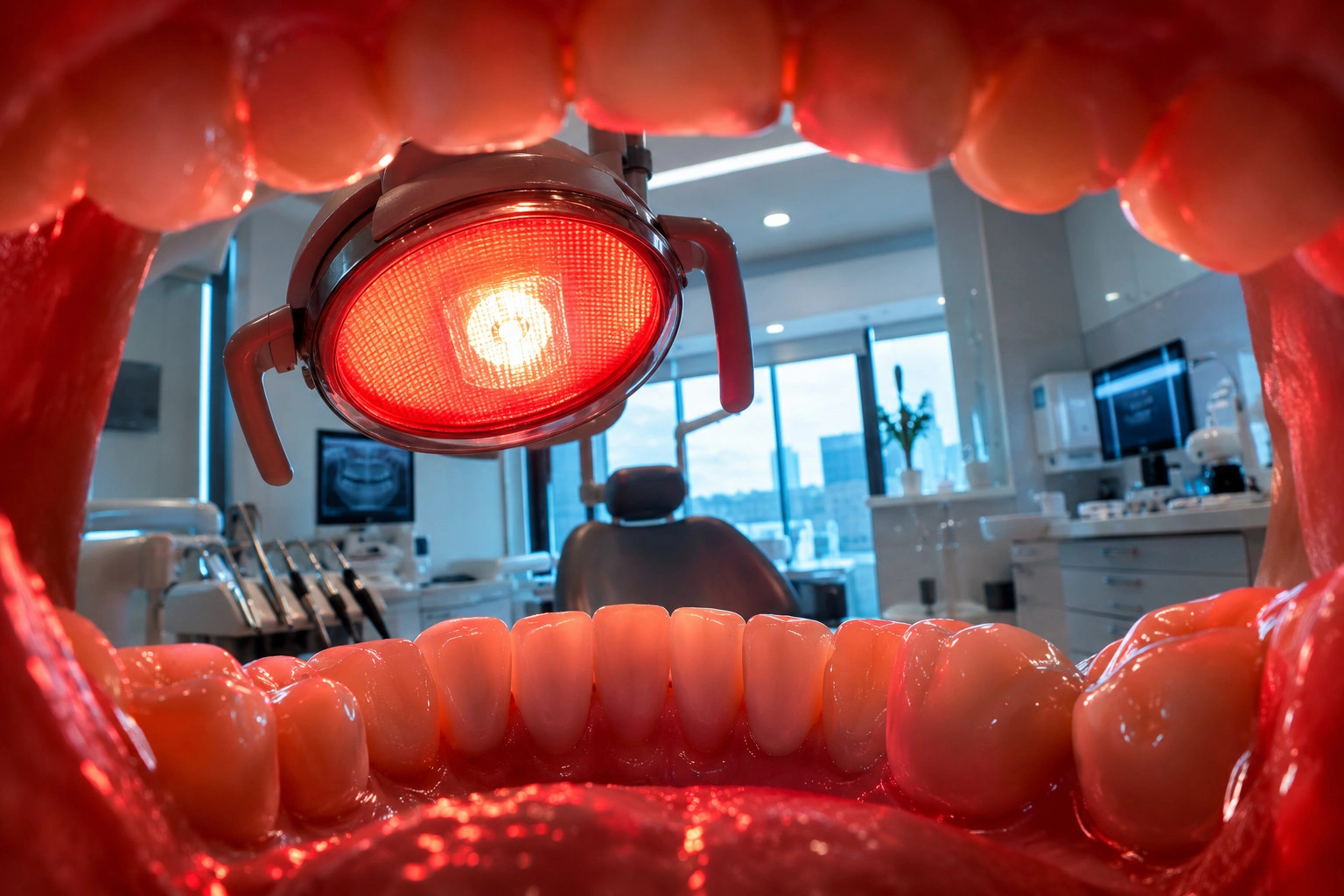
It’s a supporting remedy, as is red and near infrared light.
There are hundreds of published, peer-reviewed papers on its advantages in healing and maintaining restored oral health.
Numerous studies and controlled trials have shown that these wavelengths enhance soft tissue repair by stimulating the mitochondria and nurturing new blood vessel growth in the damaged gums.
The use of red and infrared light – photobiomodulation (PBM) – greatly reduces gingival inflammation and pain. Non-thermal, it involves photochemical and photophysical changes to light-absorbing molecules that sweep specific wavelengths of light in a pulsating pattern between 50 to 2000 Hz. Also known as low-level light therapy (LLLT) it is medically recognised as a safe and effective treatment with demonstrated therapeutic results.
What needs clarifying, is that no device that can be used at home will promote the regrowth of receding gums.
These are wellness products that do not remotely replace regular, professional dental care.
In consultation with your clinician, they may be a useful home-care addition to the undergoing treatment, but once gingival tissue is destroyed there is no way to restore the gum line without surgical intervention.
Across social media are uploads of countless Youtubers and influencers presenter-handing personal, anecdotal and unverified oracles of their outstanding red-and-infrared light oral overhaul. They’re oneiric. What they’re experiencing or seeing in firmer, healthier-looking gums is not because they’ve regrown. but because the swelling and bleeding of inflamed tissue has reduced with improved blood circulation.
Clearly, that’s a good thing: and it’s cellular repair, not tissue regeneration.
Don’t believe the hype.
Turn that razzle-dazzle, big band spotlight away from the hoopla. Let your eyes adjust. Gather yourself. Gum disease and gum issues can be prevented, and they can be treated. Just not by you, blind faith and a device bought on Amazon; regardless of the price, who recommended it and how many followers they have.
Forget illusion. Seek lumen naturale. Follow the light of reason. That precise spot it lands, that point of incidence where ray-of-light contact is, is your dentist. It’s illuminating.