Opens in a new tab

New Patient Special · Your first visit, only $228 (valued at $580).

Book Now

Sialolithiasis: Salivary Gland Stones in the Guinness Book of Records

Sialolithiasis!! Sialolith!! Hasenpfeffer Incorporated …

If Laverne & Shirley ever had this most common disease of saliva stones, no doubt that’s what they would have said.

Sialolithiasis – its medical term – accounts for more than 50% of salivary gland diseases, affects males more frequently than females and is very rarely seen in children. More than 80% of this salivary calculi form in the submandibular gland in the lower jaw; a tiny tube network and main canal that carries saliva to the floor of the mouth. Although the parotid glands situated near each ear, are the largest of these salivary transporters it is truly atypical – having somewhat less than a 10% chance – for calcified blockages to be found here, the sublingual gland directly under the tongue, or in any of other minor salivary glands.

The human body’s three major oral secretory organs (parotid, submandibular and sublingual) are a spit in the bucket.

Up to a thousand microscopic structures under the mucosal lining of the lips, mouth, tongue and palate create and deliver saliva to where it’s needed.

Without it we would die.

Not that it would necessarily be immediate, but its absence certainly creates life-threatening disorders. Malnutrition from not being able to swallow or digest food, along with whatever deep tissue infections carried to the bloodstream from the bacteria of a dry mouth, would be exacerbated by the inability to cry for help.

At some point, we’ve all certainly had the feeling we would “die of thirst” that registers anywhere on a scale from wanting a cup of tea, to being someplace, stranded and isolated without any water. It’s a sobering thought. Imagine too, what it would be like being that position and last-minute gratefully come across, or be handed that much-needed water; only to find upon drinking it, that the dry mouth you had was here to stay.

Your biological spit system had sputtered to a halt.

This lubricative, extracellular fluid is vital. Our swallowing reflex relies on it. Saliva triggers the pharyngeal receptors as many as 900 times a day, involuntarily clearing the mouth and throat, and stopping us looking like dribbling idiots whether we are or not. Only babies get away with it, and not for very long. That weird oral pressure-spray experienced eating citrus is called ‘gleeting’ by the way; as ugly a sound as the sensation. When something goes wrong with the availability, volume or viscosity of saliva it’s not something to be spat upon.

As is the order of most disorders of the human body, it can happen for a number of reasons.

The short list of usual suspects is physical trauma, radiation therapy, issues of autoimmunity, bacterial infections and blockages. It can be a lot for five-to-six centimetres of hard workin’ soft tissue, blood vessels and nerves to endure. No doubt tinier parts in the vastness of all that is human biology have a worse time; but it’s not a competition even though last one standing wins.

Blockages and bacterial infections are the most common of spitty afflictions, and not in that order.

Acute and chronic infection, known as sialadenitis, is the inflammation of salivary glands and ducts caused by pathogens from the stagnant fluid. The disrupted flow may or may not be the result of a saliva stone. Salivary calculi (or calculus; singular) is the standard clinical term for this crystallisation of minerals in saliva, which serves to make it sound much prettier than it is. Sialadenitis can be the cause or result of a sialolith, and possibly an entire sialolithiasis family of various sizes. It can create a cycle as painful and tedious as an entire series rerun of ‘Passions’.

The environment for its accumulation and growth is generally dehydration, medication, inadequate oral care, an illness like the mumps, and any combination thereof.

These crystallisations are generally between 2-8mm; similar in dimension to a rice grain.

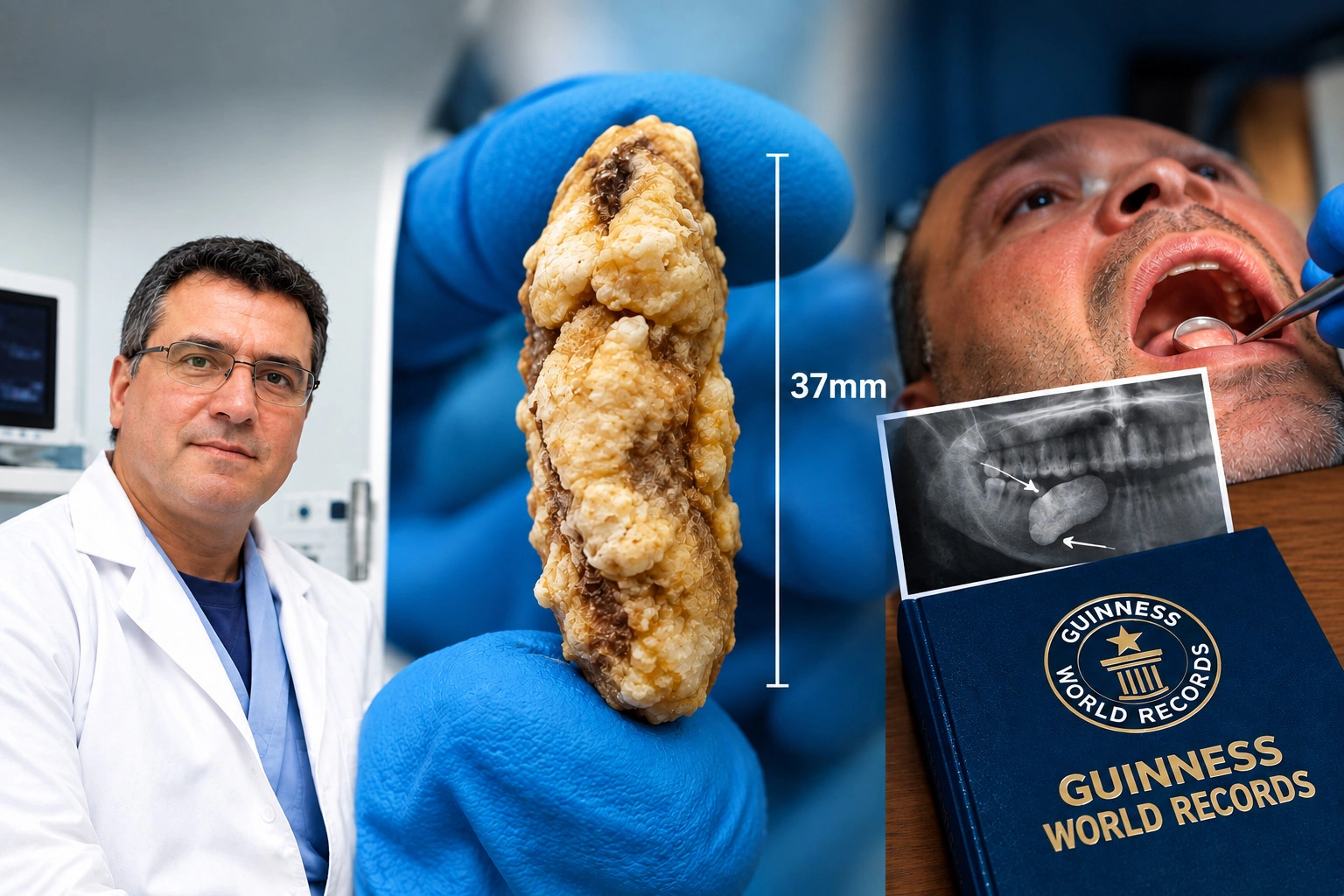
Giant sialolith, or megaliths are exceptionally-sized stones larger than 15mm. Few people had ever heard of Dr Kyprianos Kakouris, until a 43-year-old man turned up to his Cyprus medical centre in 2006 and had a massive 37mm one extracted, and then grossly included in the Guinness Book of Records.

Few people, plus you and me, have heard of him now.

Round, oval or cylindrical in shape, these stones can be white, yellow or yellow-brown, and can appear either as tiny particles or one solid mass. They won’t always show up in an x-ray because their opacity relies on the degree of calcification. When necessary, ultrasound is the preferred diagnostic medium, with CT scans used for complex cases.

Treatment options are based on size: from gentle massaging of the gland, and saliva-producing medications, to surgical removal. Even that is on a scale of simple-to-not.

A sialendoscopy is when a fibre-optic camera and micro-basket are inserted into the natural opening of the duct to release the blockage and bring it out in a basket nobody wants to look in. If it’s located on the floor of the mouth, local anaesthetic and a small incision over the offending area is the normal course of action. Deeply embedded, or stones of Guinness Book of Records dimensions, require more complex surgery with a risk of nerve irritation or damage to the lower jaw or tongue. In rare cases where there’s permanent impairment to a salivary gland, removal is necessary via a surgical incision in the neck.

The most mega megalith case spanned 60 years.

A most unfortunate 85-year-old Saudi man was repeatedly misdiagnosed by different hospitals from the age of 25. Each time, the recurring swelling in his neck and left lower jaw was treated with antibiotics for either dental and sebaceous gland infections, and lipoma. The mass was bony hard, non-tender, and saliva flow was normal except from the corresponding submandibular gland. Reviewing an x-ray taken more than a decade earlier showed the same, but smaller, calcified mass. A CT scan revealed a crystallised lesion measuring 30mm long, 20mm wide, and with a girth of 15mm.

It didn’t make the Guinness Book of Records because clearly, size matters and duration doesn’t.

As the longest time ever recorded of the presence of this disease, aside from proving that saliva stones grow over time (how was that surprising?) it showed an irregular shape never seen before. Neither round or oval, and despite its approach to the hyoid bone, it had no serious effect on any of the vital structures nearby.

What remains as more than curious, is that no scan, ultrasound or MRI had ever been suggested over that sixty year period. It had produced a prominent presence for the exceedingly patient patient, and due to his age and the longstanding acceptance of the change to his facial aesthetic, the standard sialoadenectomy for its removal was refused.

After six decades, the thought of getting rid of it must have felt like being between a rock and a hard place. Maybe the stone was his rock on the hard road of life. Maybe he secretly called it “Rocky”. Maybe it reminded him how much you can take and keep moving forward. Whatever it was, at 85 he still had life licked.
DISCLAIMER:
The content has been made available for informational and educational purposes only. Pitt Street Dental Centre does not make any representation or warranties with respect to the accuracy, applicability, fitness, or completeness of the content.

The content is not intended to be a substitute for professional personal diagnosis or treatment. Always seek the advice of your dentist or another qualified health provider with any questions you may have regarding a dental or medical condition. Never disregard professional advice or delay seeking it because of something you have read or seen on the Site.

Sidebar Banners Pitt Street Dental CentrePayment Plans Pitt Street Dental Centre
Sialolithiasis: Salivary Gland Stones in the Guinness Book of Records

Sialolithiasis!! Sialolith!! Hasenpfeffer Incorporated …

If Laverne & Shirley ever had this most common disease of saliva stones, no doubt that’s what they would have said.

Sialolithiasis – its medical term – accounts for more than 50% of salivary gland diseases, affects males more frequently than females and is very rarely seen in children. More than 80% of this salivary calculi form in the submandibular gland in the lower jaw; a tiny tube network and main canal that carries saliva to the floor of the mouth. Although the parotid glands situated near each ear, are the largest of these salivary transporters it is truly atypical – having somewhat less than a 10% chance – for calcified blockages to be found here, the sublingual gland directly under the tongue, or in any of other minor salivary glands.

The human body’s three major oral secretory organs (parotid, submandibular and sublingual) are a spit in the bucket.

Up to a thousand microscopic structures under the mucosal lining of the lips, mouth, tongue and palate create and deliver saliva to where it’s needed.

Without it we would die.

Not that it would necessarily be immediate, but its absence certainly creates life-threatening disorders. Malnutrition from not being able to swallow or digest food, along with whatever deep tissue infections carried to the bloodstream from the bacteria of a dry mouth, would be exacerbated by the inability to cry for help.

At some point, we’ve all certainly had the feeling we would “die of thirst” that registers anywhere on a scale from wanting a cup of tea, to being someplace, stranded and isolated without any water. It’s a sobering thought. Imagine too, what it would be like being that position and last-minute gratefully come across, or be handed that much-needed water; only to find upon drinking it, that the dry mouth you had was here to stay.

Your biological spit system had sputtered to a halt.

This lubricative, extracellular fluid is vital. Our swallowing reflex relies on it. Saliva triggers the pharyngeal receptors as many as 900 times a day, involuntarily clearing the mouth and throat, and stopping us looking like dribbling idiots whether we are or not. Only babies get away with it, and not for very long. That weird oral pressure-spray experienced eating citrus is called ‘gleeting’ by the way; as ugly a sound as the sensation. When something goes wrong with the availability, volume or viscosity of saliva it’s not something to be spat upon.

As is the order of most disorders of the human body, it can happen for a number of reasons.

The short list of usual suspects is physical trauma, radiation therapy, issues of autoimmunity, bacterial infections and blockages. It can be a lot for five-to-six centimetres of hard workin’ soft tissue, blood vessels and nerves to endure. No doubt tinier parts in the vastness of all that is human biology have a worse time; but it’s not a competition even though last one standing wins.

Blockages and bacterial infections are the most common of spitty afflictions, and not in that order.

Acute and chronic infection, known as sialadenitis, is the inflammation of salivary glands and ducts caused by pathogens from the stagnant fluid. The disrupted flow may or may not be the result of a saliva stone. Salivary calculi (or calculus; singular) is the standard clinical term for this crystallisation of minerals in saliva, which serves to make it sound much prettier than it is. Sialadenitis can be the cause or result of a sialolith, and possibly an entire sialolithiasis family of various sizes. It can create a cycle as painful and tedious as an entire series rerun of ‘Passions’.

The environment for its accumulation and growth is generally dehydration, medication, inadequate oral care, an illness like the mumps, and any combination thereof.

These crystallisations are generally between 2-8mm; similar in dimension to a rice grain.

Giant sialolith, or megaliths are exceptionally-sized stones larger than 15mm. Few people had ever heard of Dr Kyprianos Kakouris, until a 43-year-old man turned up to his Cyprus medical centre in 2006 and had a massive 37mm one extracted, and then grossly included in the Guinness Book of Records.

Few people, plus you and me, have heard of him now.

Round, oval or cylindrical in shape, these stones can be white, yellow or yellow-brown, and can appear either as tiny particles or one solid mass. They won’t always show up in an x-ray because their opacity relies on the degree of calcification. When necessary, ultrasound is the preferred diagnostic medium, with CT scans used for complex cases.

Treatment options are based on size: from gentle massaging of the gland, and saliva-producing medications, to surgical removal. Even that is on a scale of simple-to-not.

A sialendoscopy is when a fibre-optic camera and micro-basket are inserted into the natural opening of the duct to release the blockage and bring it out in a basket nobody wants to look in. If it’s located on the floor of the mouth, local anaesthetic and a small incision over the offending area is the normal course of action. Deeply embedded, or stones of Guinness Book of Records dimensions, require more complex surgery with a risk of nerve irritation or damage to the lower jaw or tongue. In rare cases where there’s permanent impairment to a salivary gland, removal is necessary via a surgical incision in the neck.

The most mega megalith case spanned 60 years.

A most unfortunate 85-year-old Saudi man was repeatedly misdiagnosed by different hospitals from the age of 25. Each time, the recurring swelling in his neck and left lower jaw was treated with antibiotics for either dental and sebaceous gland infections, and lipoma. The mass was bony hard, non-tender, and saliva flow was normal except from the corresponding submandibular gland. Reviewing an x-ray taken more than a decade earlier showed the same, but smaller, calcified mass. A CT scan revealed a crystallised lesion measuring 30mm long, 20mm wide, and with a girth of 15mm.

It didn’t make the Guinness Book of Records because clearly, size matters and duration doesn’t.

As the longest time ever recorded of the presence of this disease, aside from proving that saliva stones grow over time (how was that surprising?) it showed an irregular shape never seen before. Neither round or oval, and despite its approach to the hyoid bone, it had no serious effect on any of the vital structures nearby.

What remains as more than curious, is that no scan, ultrasound or MRI had ever been suggested over that sixty year period. It had produced a prominent presence for the exceedingly patient patient, and due to his age and the longstanding acceptance of the change to his facial aesthetic, the standard sialoadenectomy for its removal was refused.

After six decades, the thought of getting rid of it must have felt like being between a rock and a hard place. Maybe the stone was his rock on the hard road of life. Maybe he secretly called it “Rocky”. Maybe it reminded him how much you can take and keep moving forward. Whatever it was, at 85 he still had life licked.
DISCLAIMER:
The content has been made available for informational and educational purposes only. Pitt Street Dental Centre does not make any representation or warranties with respect to the accuracy, applicability, fitness, or completeness of the content.

The content is not intended to be a substitute for professional personal diagnosis or treatment. Always seek the advice of your dentist or another qualified health provider with any questions you may have regarding a dental or medical condition. Never disregard professional advice or delay seeking it because of something you have read or seen on the Site.

Sidebar Banners Pitt Street Dental CentrePayment Plans Pitt Street Dental Centre
Vallery Allbeury Manager   Pitt Street Dental Centre

Hi, you’re chatting with Pitt Street Dental Centre. If you could please fill out all your details below, we will be in contact with you shortly.

Pitt Street Dental Centre Price ListDOWNLOAD PRICE LIST

Please enter your mobile number and email address so we can send you the price list via SMS and email along with some of our patients’ smile transformations in the next few minutes.

Pitt Street Dental Centre Price ListDOWNLOAD PRICE LIST

Please enter your mobile number and email address so we can send you the price list via SMS and email along with some of our patients’ smile transformations in the next few minutes.

[gravityform id="5" title="false" description="false" ajax="true"]
Vallery Allbeury Manager   Pitt Street Dental Centre

Hi, you’re chatting with Pitt Street Dental Centre. If you could please fill out all your details below, we will be in contact with you shortly.

[gravityform id="2" title="false" description="false" ajax="true"]